22-Hour Course

Lesson no. 4

The Nervous System

The nervous system includes the brain and all the nerves in the human body. Its main function is to regulate our actions – voluntary and involuntary.


We divide the nervous system into two sections:


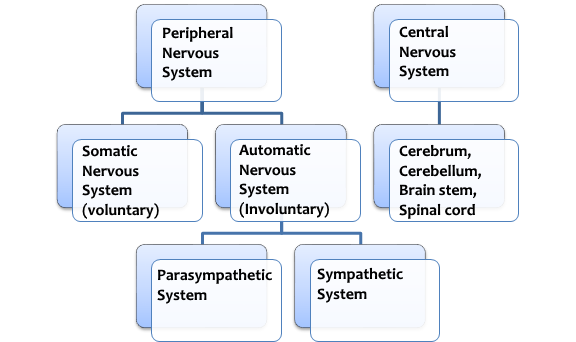
  • Central Nervous System (CNS) – the control center of the nervous system and the whole body in general, in other words: the brain and spinal cord.
  • Peripheral Nervous System (PNS) – receives stimuli from the external or internal environment and receives signals from the brain. It consists of nerve cells (neurons) that exit the spinal cord and return to it.
Central Nervous System

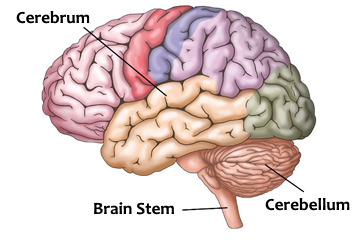
The Central Nervous System includes the four parts of the brain:


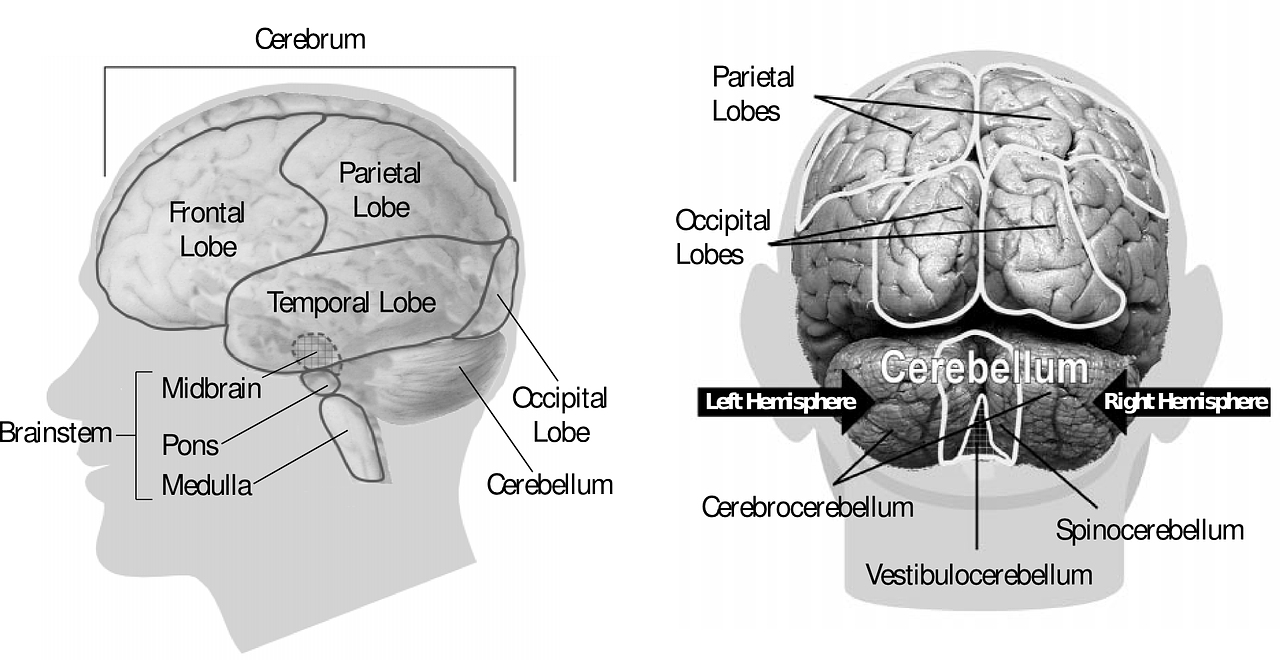
  • The cerebrum – consisting of two hemispheres (two sections split down the middle). This part of the brain is responsible for learning, thinking, sensing, motor functions, and human activities.


It consists of four lobes: frontal, parietal, occipital and temporal, as shown in the diagram:

The Nervous System
  • The cerebellum – mainly responsible for balance, coordination, muscle tone, and precise movement.
  • The brain stem – responsible for basic life functions, including breathing, contraction of the heart, contraction of blood vessels, determining the level of consciousness, etc. Among other things, it is responsible for regulating temperature, hormones and glucose, eye movements, pupil size, and reflexes.
  • The spinal cord – bridges the central nervous system with the peripheral nervous system.
Central nervous system

The Peripheral Nervous System

The peripheral nervous system is also divided into two segments:


  • The somatic nervous system (or: voluntary) – motor actions we’ve decided to perform, such as getting up, walking, touching an object.
  • Autonomic nervous system (or: involuntary) –increased heart rate when nervous, sweating, etc.


The autonomic nervous system is also made up of two systems: the sympathetic system – which works mainly during stress (primary hormone – adrenaline), and the parasympathetic system that functions mainly during times of rest (primary hormone – acetylcholine).


The two systems always work together, in a balance that varies according to the body’s needs.


The diagram below shows the distribution:

The Peripheral Nervous System

Protective Layers

The brain’s protective layers (from the outside inward):


  • Hat/Helmet – provides thermal and physical protection (helmet).
  • Hair – provides thermal protection.
  • Scalp – full of many small capillaries, nourishes the hair and wraps around the skull to regulate temperature and prevent contaminants from entering the body.
  • Skull – a strong bone that provides physical protection for the brain (a kind of shock absorber).
  • The three membranes of the brain – dura mater, arachnoid mater, pia mater.
Protective layers

Levels of consciousness

The nervous system is responsible for the level of consciousness.


On the level of First Aid responder, we discuss the four levels of altered consciousness according to AVPU:

  • Alert – alert, responds to external stimuli.
  • Verbal – Semiconscious, responds to vocal stimulation only (for example, calling out their name).
  • Pain – Semiconscious, responds to physical stimulation of pain only (for example, pinching the trapezius or rubbing the sternum).
  • Unresponsive – Unconscious, does not respond to external stimuli.

did you know?

  • Nervous systems exist in almost every living being except sponges. The role of the nervous system is to receive stimuli from the environment, analyze this information and use it to monitor the body’s behavior both consciously and unconsciously.
  • The speed of information transmitted within the brain is a few kilometers per hour and can reach speeds of up to about four hundred kilometers per hour.
  • One example of the nervous system in action is reflexes. Reflex is an immediate and involuntary response to nerve stimulation. Reflexes contribute to our survival by producing an immediate response to certain situations and thus may save our lives, such as when touching a hot oven and quickly moving our hands away. During normal neural processing, information comes from the sensor and reaches the brain, where the information is processed, and decisions are made. During reflex action, the processing is already happening in the spinal cord or brain stem, so the response is much faster.
Accessibility