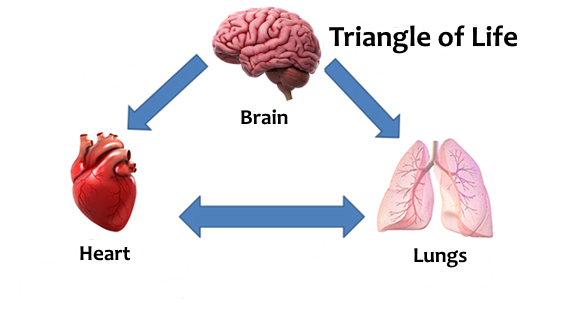
The “Triangle of Life” is a schematic diagram (as depicted in the picture) that represents the three main systems of the human body:
- The nervous system is at the top of the triangle because it activates, controls, and regulates the entire body’s systems. Cells from the nervous system are unique in that dead cells cannot be renewed, so any damage to the brain is irreversible.
- At the base of the triangle to the right is the respiratory system, whose primary purpose is to exchange oxygen (which enters our bodies through inhalation) into carbon dioxide (which exits our bodies through exhalation). The exchange of gases in the alveoli is completely passive and doesn’t require any energy, therefore rapid and high-quality oxidation administered to an unconscious person may prevent ischemic damage to all of the body’s systems.
- At the base of the triangle to the left is the circulatory system, whose main purpose is to provide oxygen-rich blood to all the cells in our body, and clear out the carbon dioxide. During CPR, we simulate cardiac activity by performing chest compressions to provide oxygenated blood to prevent irreversible damage to the brain as well as prevent brain death and clinical death.
The collapse of any of these systems will lead to the collapse of all three, and cause death.
 Students Login
 Teachers Login